
iSense
Mattress shopping has long followed a predictable script. A visit to a brightly lit store, a series of quick tests on unfamiliar beds, and a decision made under mild pressure. For many consumers, the process feels disconnected from how sleep actually happens.
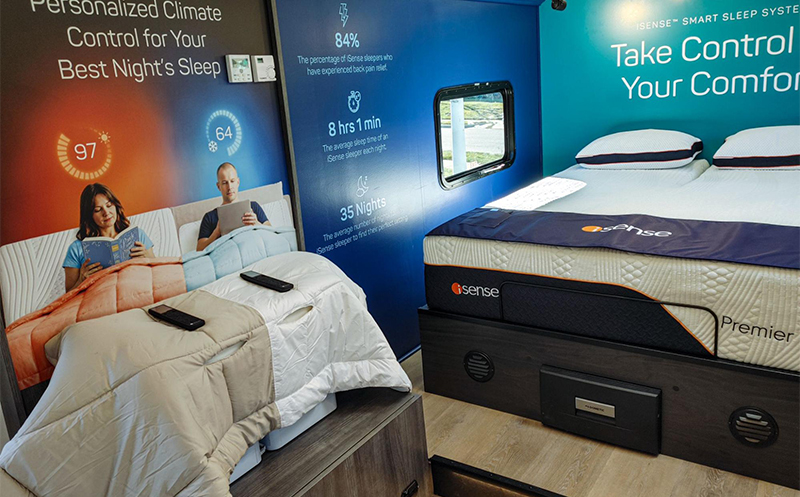
A new approach is taking shape in Dallas. iSense, a company focused on customizable sleep systems, has introduced a mobile showroom designed to bring the retail experience directly to the customer’s driveway. The concept is straightforward in its execution but notable in its implications. Instead of asking shoppers to adapt to a store, the showroom adapts to them.
The rollout comes as part of a pilot program in the Dallas-Fort Worth area, a region selected for its continued population growth and demand for home-focused solutions. The mobile unit functions as a compact retail space, equipped with full-size mattresses, digital tools, and guided demonstrations. Customers book appointments online and receive a one-on-one consultation without leaving home.
The timing aligns with a broader shift in how consumers approach major household purchases. In categories ranging from furniture to appliances, there is increasing interest in experiences that prioritize convenience and personalization. Sleep products, despite their importance, have often lagged behind in this transition.
The traditional showroom model presents limitations. Lighting, layout, and time constraints can all influence perception, making it difficult to assess comfort accurately. A mattress that feels suitable in a store may perform differently in a home setting, where factors such as room temperature, noise, and personal routines come into play.
By contrast, the mobile showroom places evaluation within the context where the product will actually be used.
iSense’s offering centers on its adjustable hybrid mattress, which allows each side of the bed to be configured independently. The system is supported by the company’s Comfort Control technology, which lets users fine-tune firmness levels in real time. During the in-home consultation, customers can test different settings while receiving guidance from a trained sleep specialist.
This level of customization reflects a broader trend within the sleep industry. As awareness grows around the link between sleep quality and overall health, consumers are placing greater emphasis on finding solutions that match individual preferences rather than defaulting to standard options.
Dallas presents a fitting environment for this kind of pilot. The region’s housing landscape, which includes a mix of new developments and established neighborhoods, supports in-home services that can be scheduled with relative ease. At the same time, local consumers have shown a willingness to adopt products that combine technology with everyday convenience.
For iSense, the mobile showroom is not positioned as a one-off experiment. The company has outlined plans to expand the concept to additional markets, with the potential to deploy multiple units each quarter over the coming years. If the Dallas pilot performs as expected, the approach could reshape how sleep products are introduced and evaluated across a wider audience.
There is also a practical element to the model that extends beyond convenience. By limiting the need for large retail footprints, mobile showrooms may offer a more flexible way to reach customers while reducing overhead associated with traditional storefronts. That flexibility could allow for more targeted deployment in areas where demand is strongest.
For consumers, the immediate appeal lies in simplicity. Scheduling an appointment, stepping outside, and testing a product in a familiar setting removes several layers of friction from the process. It also creates space for more deliberate decision-making, without the time pressures that often accompany in-store visits.
While much of that conversation focuses on habits and routines, the environment in which people sleep remains a critical factor. By bringing the showroom to the home, iSense is testing a different way of addressing that factor. The concept does not rely on changing how people shop entirely, but it does adjust where and how those decisions take place.
In a category where comfort is difficult to measure quickly, that shift may prove meaningful. For Dallas residents, it begins with a visit that arrives at the curb rather than the mall.